
Clay County Scheduled Release
A projected release date is a scheduling calculation. It is not always the actual date a person walks out. In a Clay County jail case, the release may depend on bond, court order, sentence credit, another agency hold, transport, or jail processing. In an Alabama state-prison case, ADOC uses defined release-date fields, but those fields can change. In a federal case, the Bureau of Prisons uses its own inmate locator and federal records.
Scheduled vs actual: A scheduled or minimum release date is the best available date from the responsible custody system. Actual release can change because of court action, good-time changes, detainers, parole action, supervision rules, or administrative processing.
The first question is not "what website has the date?" It is "which agency has the person?" A person held pretrial in the Clay County Detention Center may have a bond path, not a computed prison date. A person sentenced to ADOC may show a Minimum Release Date and a Parole Consideration Date. A person serving a federal sentence belongs in the BOP system, not the county roster.
Clay County Release Paths
Clay County release-date work should separate county jail, Alabama state prison, and federal custody. The Clay County jail roster answers current local custody, but it does not publish a separate projected-release field. ADOC dates apply only after a person is in state-prison custody. BOP dates apply after federal sentencing. A person can also move from one path to another by transfer, commitment, detainer, or court order.
| Custody path | Where the date comes from | Main caution |
|---|---|---|
| Clay County jail | Court order, bond status, jail credit, sentence, hold, or jail release record. | No separate public projected-release-date field was located for the county roster. |
| ADOC state prison | ADOC current-inmate profile, sentence data, Minimum Release Date, and parole fields. | ADOC says historical data is not available online through the public search. |
| BOP federal prison | BOP inmate locator and federal sentence computation. | A BOP release date confirms federal custody status, not the Clay County jail release reason. |
Find Clay County Release Date
Use the custody path first, then the date field. If a person is still in Clay County jail, the jail and court record control. If the person has been committed to ADOC, the state inmate profile is the useful public path before release. If the person is in federal prison, use BOP. For a named person who has already left local custody, the broader released-inmate search path on Clay County released inmates may be more useful than a projected-date query.
- Check whether the person is still listed in Clay County jail custody through the sheriff's current-inmate route. If listed, the roster confirms current custody at the posted timestamp, not a firm release date.
- If the person is a county detainee, contact the Clay County Detention Center or review the court record for bond, sentence, jail credit, time served, hold, or transfer information.
- If the person has an ADOC sentence, search the Alabama Department of Corrections inmate search by AIS number when available, or by name if not.
- On an ADOC profile, compare location, custody status, sentence status, Minimum Release Date, Parole Consideration Date, and parole status if those fields appear.
- If federal custody is involved, use the BOP inmate locator. BOP explains that a past release date with no facility location means release from BOP custody on that date.
- For notice of a pending or completed custody change, use Alabama VINE/VNS for covered Alabama cases or BOP/ICE/DHS channels for federal and immigration custody.
Minimum Release Date Terms
Alabama's terminology is a common source of mistakes. ADOC defines "Minimum Release Date" as the earliest scheduled date an inmate can be released to probation or end of sentence. ADOC also defines "Parole Consideration Date" as a tentative date set by the Parole Board. Those are not the same field. A parole-consideration date is a board-review date, while the minimum release date is a sentence-computation date.
The ADOC definitions page is the key source for these terms.
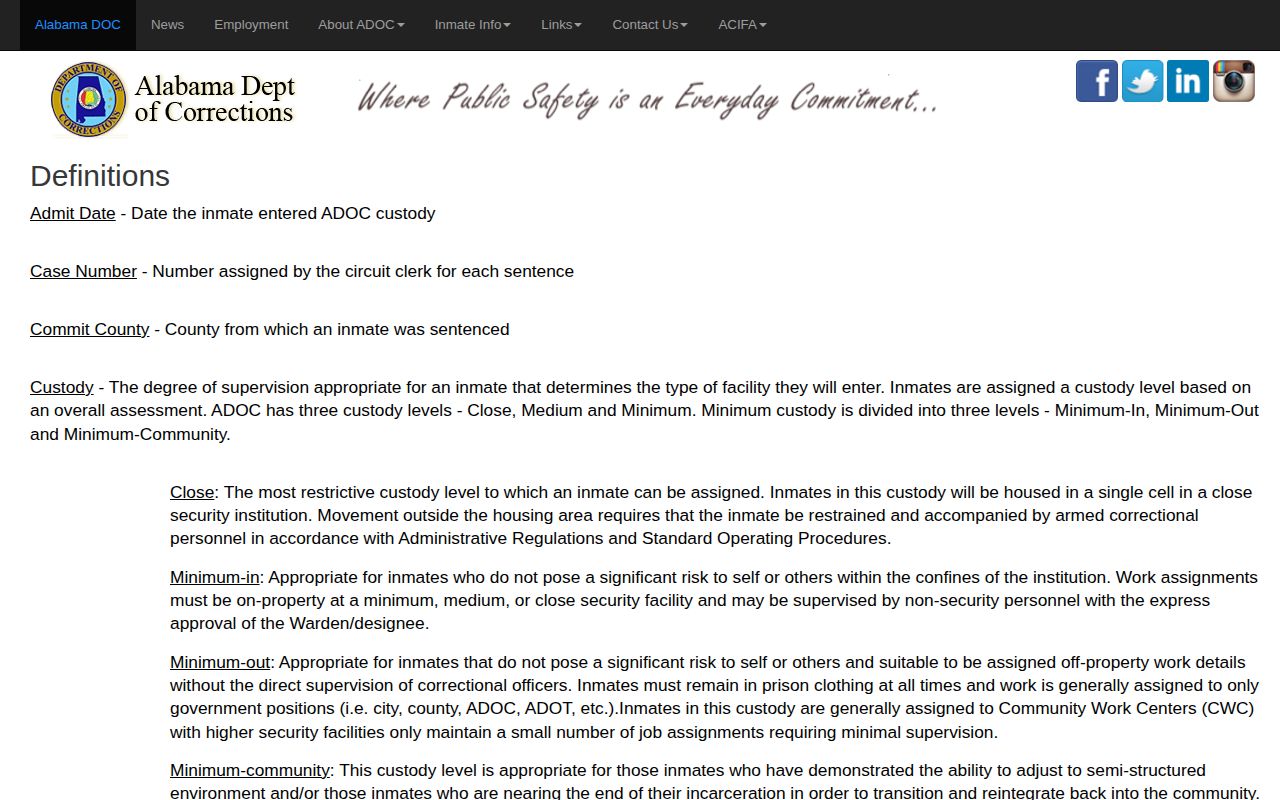
That distinction is important in Clay County cases that move from the jail to state prison, because the county record may show transfer while ADOC later controls the prison release calculation.
ADOC also warns that the Minimum Release Date can change if the inmate receives disciplinaries that remove good time or if the circuit clerk sends new cases or sentence changes. That makes the date official but still changeable. After release, the ordinary ADOC public search is limited because the public database contains only currently incarcerated inmates and historical data is not available online.
Alabama Good Time Rules
Alabama Correctional Incentive Time is the state's main good-time framework for eligible state prisoners. Alabama Code Section 14-9-41 sets classes of credit. Class I receives 30 days of credit for each 30 days actually served. Class II receives 15 days for each 30 days actually served. Class III receives five days for each 30 days actually served. Class IV receives no correctional incentive time.
The exclusions matter as much as the credit amounts. The statute excludes categories such as Class A felony convictions, certain deadly-weapon deaths, life or death sentences, sentences over 15 years, and child sex offenses as defined in the statute. Because of those exclusions, Clay County release-date copy should not reduce Alabama good time to a single percentage for all prisoners.
Education incentive time is a separate state-prison factor. Alabama Code Section 14-9-64 may reduce incarceration by up to 12 months during a term of incarceration and is in addition to other available sentence deductions. It should be discussed only as a state-prison sentence factor unless a case record shows that it applies.
Good-time note: Section 14-9-41 can reduce an eligible ADOC sentence, but class placement, exclusions, discipline, and new sentence information can change the computed date.
Truth Sentencing and Supervision
Alabama has voluntary truth-in-sentencing standards, but the research did not locate a universal Alabama rule that every state prisoner simply serves 85 percent. Alabama Code Section 12-25-36 describes sentences imposed under voluntary truth-in-sentencing standards as including a minimum sentence and an extended sentence, with post-release supervision when imposed under those standards. That is a state sentencing framework, not a one-number answer for every Clay County case.
Mandatory supervision is another release-date issue. ADOC's mandatory supervision release notice explains changes tied to Alabama Code Section 15-22-26.2 that took effect January 31, 2023. Eligible inmates began being released to ABPP supervision under those changes, with victim-notification and electronic-monitoring references in the release notice. For release-date purposes, that means a person can leave prison custody and still be under ABPP supervision.
The parole date is separate. Alabama Code Section 15-22-28 addresses parole investigation and scheduling rules. A hearing may be granted, denied, continued, cancelled, or later affected by revocation or delinquency. Those board events can affect release timing, but they are not the same as the actual physical release date.
Why Clay Release Dates Change
A projected release date changes when the underlying sentence, credit, custody status, or release authority changes. Some changes are internal to ADOC, such as discipline or class status. Others come from court action, the circuit clerk, parole-board action, a detainer, or a new hold. County jail release timing can also shift because bond paperwork, release processing, transport, or another agency hold is not complete.
| Reason the date changes | How it affects a Clay County release date |
|---|---|
| Good-time loss or discipline | ADOC may move the Minimum Release Date later if correctional incentive time is lost. |
| New case or amended sentence | Sentence information from the circuit clerk can alter ADOC's computation. |
| Parole grant, denial, or continuance | Board action can create, delay, or remove a parole-release path. |
| Detainer, warrant, or other hold | The person may leave one custody source but transfer to another agency. |
| Bond or court order change | A county detainee may be released sooner or later based on the judge's order. |
| Mandatory supervision processing | Eligibility, notice requirements, and ABPP supervision can affect the release path. |
Clay County Jail Dates
A Clay County jail release date is usually a local records question, not an ADOC calculation. The Clay County Detention Center contact record can help route jail questions, and the release record may show release date and time, release reason, bond, time served, transfer destination, or another agency hold. The Clay County court record may show the bond order, sentencing order, probation order, dismissal, revocation, or sentence-completion entry that explains why the jail released or transferred the person.
Pretrial detainees are the clearest example. They do not have a fixed release date just because they are in jail. Release may turn on bond, a court hearing, dismissal, a hold, or transfer. Sentenced county-jail cases can have a more concrete release date, but it still depends on the sentence, jail credit, court order, and holds. When the person disappears from the current roster, confirm whether that was release to the community or transfer to ADOC, another county, federal custody, or immigration custody.
Clay County Detention Center
41771 Hwy 77, Suite 2
Ashland, AL 36251
Jail phone: 256-354-7713
Ask for the custody status, release date, release reason, and transfer destination if any.
Clay County Circuit Clerk
Clay County Courthouse
25 Court Square, Ashland, AL 36251
Phone: 256-354-7926
Use for bond, disposition, sentence, probation, and court-order checks.
Confirm Clay County Release
Confirmation should match the custody system. For Clay County jail, confirm with the jail and the court record. For state prison, confirm with ADOC while the person is current, then use ABPP, VNS, court records, or an ADOC records request after release. For federal prison, use BOP. For immigration custody, ICE and DHS VINE are separate federal channels. None of those systems should be treated as a full substitute for the official release record from the agency that held the person.
Alabama VINE and VNS can help with covered alerts, especially when a custody change is pending or has just occurred. The VINELink inmate check path is best for a specific person or case alert. Still, a notification should be verified with the originating jail, court, ADOC, ABPP, BOP, or ICE source before relying on the date, reason, or status.
Note: If the listed release date is in the past and no BOP facility location appears, BOP says the person was released from BOP custody on that date.