
Clay County Parole and Probation
Clay County parole and probation are both forms of supervision, but they begin in different ways. Parole usually follows a state-prison sentence and is tied to a decision by the Alabama Board of Pardons and Paroles. Probation is a court sentence or court order that lets a person serve part or all of a sentence under rules in the community. Mandatory supervision and post-release supervision can also follow an Alabama Department of Corrections sentence, so a state-prison release may still involve the Alabama Bureau of Pardons and Paroles.
The county jail roster does not answer this question by itself. The Clay County Detention Center roster is current-custody oriented. Once a person leaves the jail, the better path is to identify the case result, sentence, and release reason. For a state-prison sentence, the ADOC inmate search may help while the person is still incarcerated, but ADOC says that public search contains only current inmates and historical data is not available online.
| Supervision type | What it means in a Clay County case | Where to verify |
|---|---|---|
| Parole | Conditional release from state-prison custody after board action, with rules and reporting duties. | ABPP hearing records, ABPP Ashland Field Office, ADOC/VNS when covered. |
| Probation | A court-ordered sentence or sentence term served under supervision instead of, or after, jail/prison time. | Clay County court record, probation order, ABPP office when ABPP supervises. |
| Mandatory supervision | Release from ADOC custody to supervision for eligible inmates under Alabama law. | ADOC release records, ABPP supervision contact, VNS notices when registered. |
| Community corrections | A local court or correctional program used as diversion or after incarceration for eligible cases. | Clay County Community Corrections and the sentencing court. |
- Parole
- Conditional release from state-prison custody before the full sentence expires.
- Probation
- Court supervision that is usually based on the sentencing order, not a parole-board grant.
- Absconder
- A supervised person who has stopped reporting or cannot be located by the supervising authority.
- Discharge
- The formal end of custody or supervision when the legal term is complete.
Verify Clay County Supervision
The cleanest verification starts with the release type. A person released from Clay County jail on bond may have a pending court case and no ABPP supervision. A person released from ADOC on parole or mandatory supervision may report through ABPP. A person placed in community corrections may have a local program contact and a court order. Treat each path as separate until a record connects them.
- Check the Clay County jail path first if the release started at the county facility. The Clay County Detention Center / Clay County Jail release record can show bond, time served, transfer, probation, or another release reason.
- Read the Clay County court record for the case result. A probation order, split sentence, revocation order, or community-corrections order is usually a court record issue.
- Use ABPP when the record points to parole, probation handled by ABPP, mandatory supervision, delinquency, revocation, or other state supervision.
- Use Alabama VINE or the Alabama Victim Notification System for covered custody and post-conviction notices, but treat the alert as a notice rather than the full release record.
- If the person was transferred to state prison, use ADOC before release and ABPP/VNS/court records after release because the ordinary ADOC public search is current-inmate only.
Alabama VINE is available at VINELink Alabama, and the Alabama Victim Notification System is available through victims.alabama.gov. The state victim-notification context is important because it is aimed at convicted Alabama prisoners and post-conviction events. For a case that has not reached trial, the county sheriff and court remain the more direct route.
Important: A Clay County jail release is not proof that the person is off supervision. It may only show that local custody ended.
Ashland Office for Clay Supervision
The local state supervision source is the ABPP Ashland Field Office, which serves Clay and Coosa counties. This office is the practical contact point when a Clay County record shows parole, probation supervised by ABPP, mandatory supervision, delinquency, revocation, or another state-supervision issue. It is not a county jail release desk, so callers should first know whether the person was released from jail, transferred to ADOC, or placed on a court supervision track.
The ABPP Ashland Field Office page is shown in the page capture below.
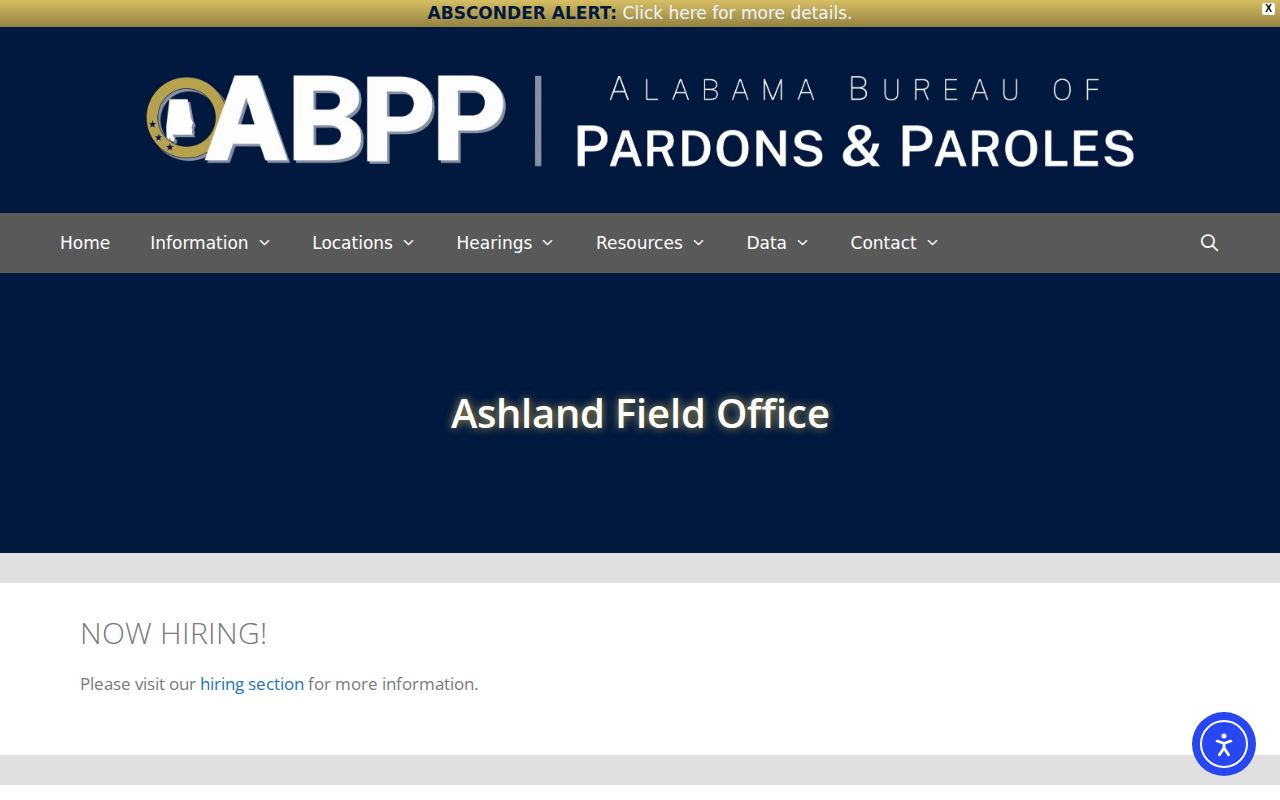
The listing matters because Clay County supervision questions often involve the same Highway 77 North complex area, while the jail itself is a separate custody source.
ABPP Ashland Field Office
41771 Highway 77 North, Suite 1
Ashland, AL 36251
Phone: 256-970-1325
Fax: 256-342-0747
Hours: Monday-Friday, 8:00 a.m.-4:30 p.m.
Closed state and federal holidays
Clay County Community Corrections
Mike Petrey, Director
41771 Hwy 77 North, Suite 1
Ashland, AL 36251
Phone: 256-252-2823
Use for community-corrections questions tied to a court or program order.
Clay County Parole Hearings
The Alabama Board of Pardons and Paroles publishes a forward-looking scheduled parole hearings page, a current-year parole results page, and a hearing-results archive. Those sources can help when a Clay County case has moved into ADOC custody and the question is whether the parole board has scheduled or decided a parole matter.
Outcome words need care. A grant means the board approved parole, but physical release can still depend on processing, conditions, notices, detainers, or another hold. A deny means parole was not approved through that hearing. A continue or defer moves the matter forward. A cancellation means the hearing did not go forward as listed. Revocation or delinquency language usually points to a supervision problem after release. None of those words alone is the same as the person walking out of a jail or prison.
Alabama Code Section 15-22-28 addresses parole investigation and hearing timing. It ties the review process to sentence length, minimum release date, and related parole rules. Some cases have separate restrictions, so a hearing date should be read as a board event, not a promise of release.
Clay County Community Corrections
Community corrections is related to supervision, but it is not the same as parole. ADOC describes Community Corrections Programs as community-based programs that may be residential or non-residential and may be ordered as a prison diversion or after incarceration. In Clay County, the ADOC statewide contact list names Clay County Community Corrections with Mike Petrey as director at the same Suite 1 address on Highway 77 North.
That local contact gives Clay County a concrete reentry and supervision route. It does not mean every released person reports to community corrections. A person released on bond from the Clay County Detention Center may be waiting on a court date. A person released from ADOC may be under ABPP. A person ordered into community corrections should have a court or program record that explains the reporting duty, the term, and the conditions.
| Record clue | Likely next source |
|---|---|
| Bond or recognizance release | Clay County court file and jail release record. |
| Parole grant or mandatory supervision | ABPP Ashland Field Office, ADOC records, VNS if covered. |
| Community-corrections order | Clay County Community Corrections and the sentencing court. |
| Probation violation or revocation | Court record plus ABPP or supervising program, depending on who supervises. |
Conditions and Absconder Status
Supervision conditions vary by case. Common conditions can include reporting, staying in contact with the supervising officer, obeying court orders, paying court-ordered amounts, attending required programs, and avoiding conduct that violates the order. The public lookup issue is narrower: determine whether a supervision record exists, who supervises it, and whether the status is active, delinquent, revoked, discharged, or otherwise closed.
An absconder or delinquent status is not a new jail release record. It usually means a person under supervision has a compliance problem, missed reporting, or cannot be located as required. A revocation can return someone to custody after release. For Clay County, the verification chain should connect the ABPP status, any court revocation record, and the jail or ADOC custody record if the person was taken back into custody.
VINELink and VNS can help with covered custody changes, but they do not replace the official supervision or court file. When the detail matters, use the originating agency. That may be the ABPP Ashland Field Office, Clay County Community Corrections, the Clay County court, ADOC, or the county jail.
Note: A supervision violation may affect custody, but it does not prove a new release date without the court or agency record.
Clay County Release Property Questions
The Clay County sheriff contact materials identify an inmate kiosk in the Sheriff's Office hallway, and the roster contact page refers to an inmate-store kiosk in the front lobby. The same sources do not publish a complete release-day property policy. That limits what can be said from public research. Money, account, and property questions after a Clay County release should be confirmed with the jail rather than inferred from the roster or a supervision listing.
This distinction matters for parole and probation because a person may handle jail release logistics at the Clay County Detention Center and then report to another office for supervision. The jail can answer custody-end, account, and facility questions. ABPP or Community Corrections can answer reporting and supervision questions only when that person is under their authority. Mixing those sources can lead to a wrong answer about where someone must report next.
How Clay County Supervision Ends
Supervision ends by discharge, expiration, court order, board action, or another lawful closure. The exact path depends on whether the person is on parole, probation, mandatory supervision, or community corrections. A discharge is not the same as release from jail. Release ends a custody episode. Discharge ends the supervision term or legal obligation tied to that supervision.
For a Clay County probation case, the Clay County court record is often the most durable public trail. For a parole or mandatory supervision case, ABPP and ADOC records are more important. For community corrections, look for the program contact and the sentencing court. Alabama public-records law, including Sections 36-12-40 and 36-12-41, supplies the starting point for public writings and copies, but sealed, juvenile, youthful-offender, expunged, and sensitive records can be restricted or redacted.